A travel rule compliance solution is the software layer that lets a virtual asset service provider collect, transmit, and receive verified originator and beneficiary information alongside crypto transfers, as required by FATF Recommendation 16. Choosing one is harder than it sounds, because the "travel rule" is not one rule: it is a family of national implementations with different thresholds, different data fields, and different enforcement dates, layered on top of a messy ecosystem of competing messaging protocols that do not all interoperate.
Quick solution
If you only need the shortlist: pick one dedicated travel rule platform that supports IVMS 101 data formatting and at least two of the major messaging protocols (TRP, Notabene's network, or Sumsub's), wire it into your transaction flow so transfers above your jurisdiction's threshold cannot settle before a data exchange completes, connect it to the identity verification stack that produces your originator records, and turn on counterparty VASP due-diligence lookups from day one. Then document your sunrise-period policy — what you do when the counterparty cannot receive data — because regulators ask for that before anything else. The rest of this guide explains each of those decisions and the failure patterns that generate findings in real examinations.
This guide explains what a travel rule compliance solution actually does, how the main architectural approaches differ, where the originator data comes from, and which implementation mistakes examiners flag most often. It is written for compliance officers and founders at exchanges, custodians, brokers, and payment firms that touch crypto transfers — not for readers who want a survey of every vendor logo in the market.
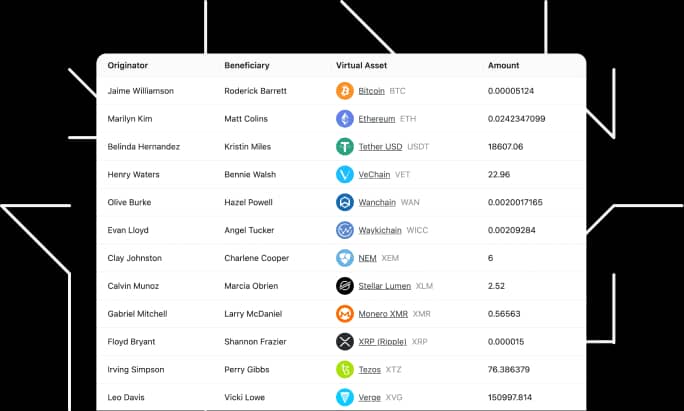
The Financial Action Task Force extended its wire-transfer rule to virtual assets on June 21, 2019, when it adopted an Interpretive Note to Recommendation 16. The obligation is straightforward to state: when a VASP sends a transfer on behalf of a customer, it must transmit the originator's name, account identifier or wallet address, and either a physical address, national identity number, customer identification number, or date and place of birth. The receiving VASP must obtain and hold the beneficiary's name and account identifier, and both sides must screen the names they receive.
What makes this operationally hard is everything the statement leaves out. Blockchains carry no native field for identity data, so the information must "travel" through a separate, off-chain channel that both VASPs support. Thresholds differ by jurisdiction: FATF suggests a 1,000 USD/EUR floor, the European Union's Transfer of Funds Regulation applies with no minimum threshold from December 30, 2024, and the United States inherits the Bank Secrecy Act's 3,000 dollar recordkeeping trigger — a figure FinCEN and the Federal Reserve proposed lowering to 250 dollars for cross-border transfers in an October 23, 2020 rulemaking that remains unfinalized. A transfer that is under-threshold in one direction can be over-threshold in the other.
The rule also reaches transfers to and from self-hosted wallets in many jurisdictions. Under the EU regime, a VASP must collect originator and beneficiary information for self-hosted wallet transfers and, above 1,000 euros, verify that its customer actually controls the external wallet. That verification — through a signed message, a micro-transaction, or screen-recorded proof of control — is a distinct workflow most generic AML tooling does not include, and it is a core reason dedicated travel rule platforms exist as a category.
The four ways firms deploy a travel rule compliance solution
Vendors package travel rule capability in genuinely different shapes, and the shape determines your integration effort, your counterparty reach, and your failure modes. Because no single public comparison lays the four deployment approaches side by side, we compiled one from vendor documentation, protocol specifications, and the regulatory texts cited at the end of this article.
| Factor | Dedicated travel rule platform | Analytics-vendor add-on | KYC-vendor bundled module | In-house protocol integration |
|---|---|---|---|---|
| What it is | Standalone product built only for R.16 data exchange (21 Analytics, Notabene) | Travel rule messaging attached to a blockchain-analytics suite | Travel rule messaging attached to an identity-verification suite (Sumsub) | Your engineers implement TRP or an open protocol directly |
| Counterparty reach | Broadest; multi-protocol gateways to other networks | Strong within the vendor's client base | Strong where counterparties share the vendor | Only counterparties on the same protocol |
| Originator data source | Pulled from your KYC stack via API | Pulled from your KYC stack via API | Native — same platform produced the identity record | Whatever you wire in |
| Self-hosted wallet verification | Usually built in, including EU proof-of-control flows | Varies; often screening-only | Included in some tiers | Build it yourself |
| Typical integration effort | Days to weeks; REST API plus webhook | Low if already an analytics customer | Low if already a KYC customer | Months of engineering |
| Best fit | Exchanges and custodians with diverse counterparties | Firms consolidating on one analytics vendor | Startups wanting one vendor for KYC plus travel rule | Large firms with protocol-level opinions |
The trap in this table is counterparty reach. A travel rule message is only useful if the VASP on the other side can receive it, and the market never converged on a single protocol. TRP, OpenVASP, Sygna, TRUST in the United States, and several vendor-proprietary networks all coexist. A solution that speaks only one protocol leaves you compliant with the counterparties on that network and silent toward everyone else — which is why multi-protocol support and gateway arrangements matter more than any single feature on a demo call.
A travel rule message is only as good as the identity record behind it. Recommendation 16 requires the ordering VASP to hold verified originator information, which means the upstream onboarding flow — not the messaging protocol — determines whether your transmissions are accurate. Firms that treat the travel rule as a pure messaging problem end up transmitting stale or unverified names and discover the gap during an examination rather than a demo.
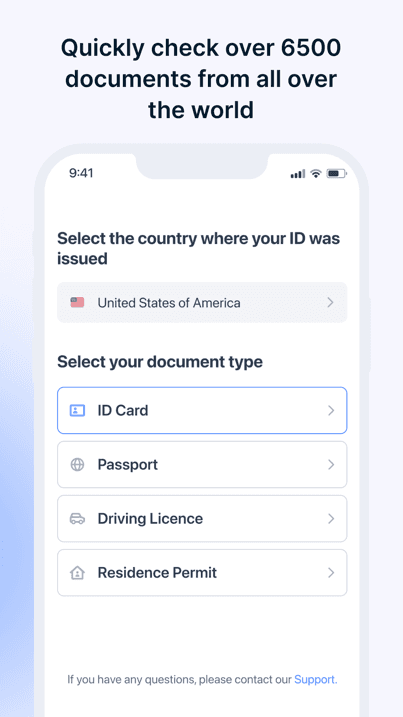
In practice the record is produced by the same KYC pipeline we walk through in our guide to KYC and KYB for digital assets: the customer selects an issuing country and document type, captures the document, passes a liveness check, and the vendor extracts and verifies the name and date of birth that later populate IVMS 101 fields.
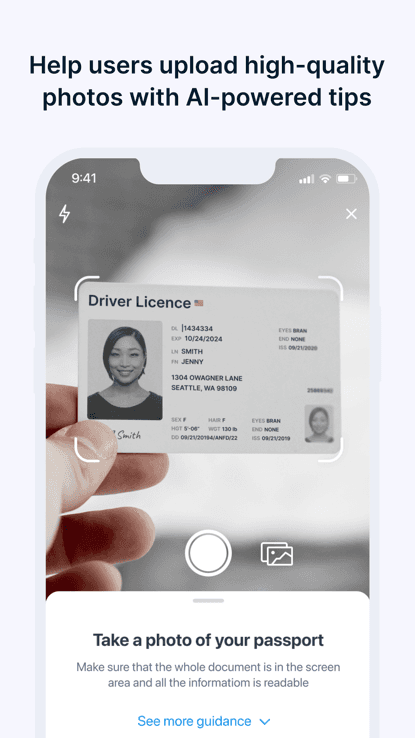
Document capture quality matters more than teams expect, because optical extraction errors propagate directly into travel rule messages. A transposed birth date or a truncated surname in the KYC record becomes a mismatched beneficiary name at the receiving VASP, which triggers a manual review queue on both sides of every transfer that customer ever makes.
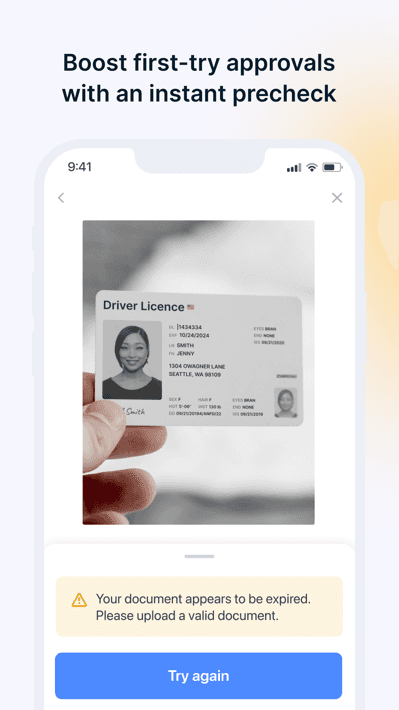
Two operational details separate mature deployments from fragile ones. First, expiry handling: identity documents age out, and a travel rule message built on an expired document is a finding waiting to happen, so good stacks pre-check validity before reuse. Second, liveness: name data lifted from a document is worthless if the document holder is not the person transacting, which is why liveness checks sit between capture and approval in every serious flow.

More in KYC & Due Diligence
The sunrise problem, counterparty due diligence, and policy enforcement
Every travel rule deployment collides with the sunrise problem: jurisdictions switched the rule on at different times, so a fully compliant VASP routinely sends transfers to counterparties that have no legal obligation — and often no technical ability — to receive the data. Your solution cannot fix that asymmetry, but your written policy must address it. The workable pattern is a documented decision tree: attempt the data exchange; if the counterparty is unreachable, record the attempt, apply risk-based controls such as enhanced monitoring or amount limits, and keep the evidence. Examiners have been far harsher on firms with no documented sunrise stance than on firms whose stance is imperfect.
Counterparty VASP due diligence is the second half of the same problem. Before transmitting personal data about your customer to another institution, you are expected to know that institution is real, licensed where it claims to be, and not sanctioned. Dedicated platforms bundle VASP directories and due-diligence questionnaires for this purpose, and the name-screening half of the workflow should reuse the same screening infrastructure we cover in our review of crypto sanctions screening tools rather than a second, parallel list stack.
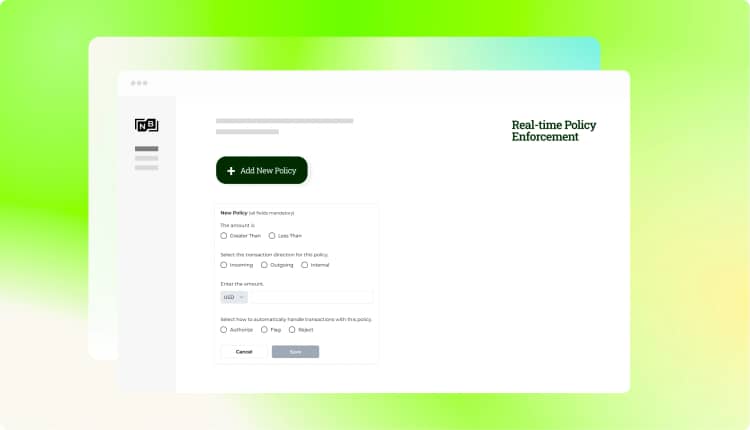
Policy enforcement is where the solution earns its keep daily. A travel rule platform that merely records transfers after settlement is an archive, not a control. The control version sits in the transfer path: a withdrawal above threshold is held until the data exchange completes and the counterparty check passes, with rules deciding automatically whether a given transfer is authorized, flagged for review, or rejected. That pre-settlement placement is the single most important architectural question to ask a vendor, and it is the same in-the-flow versus after-the-fact distinction that separates strong deployments across the broader crypto AML compliance software stack.
There is also a data-protection dimension that compliance teams sometimes discover late: a travel rule message is a cross-border transmission of personal data, which means privacy law applies to it just as fully as AML law does. European firms in particular need a lawful basis and appropriate safeguards for sending customer names and identifiers to VASPs in third countries, retention schedules for inbound beneficiary data they receive about people who are not their customers, and vendor contracts that pin down who acts as controller and who as processor. The stronger platforms address this with encrypted point-to-point exchange and data-minimization defaults, but the legal analysis is yours, not the vendor's, and examiners on both the AML and privacy side have started asking for it.
Finally, measure the program once it runs. The metrics that reveal whether a deployment actually works are unglamorous: the percentage of outbound transfers where a data exchange succeeded before settlement, median counterparty response time, the name-mismatch rate between transmitted originator data and the receiving VASP's records, and the share of transfers falling into the documented sunrise path. A falling exchange-success rate is usually the first visible sign that a counterparty changed protocols or dropped off a network — catching it in a weekly report is far cheaper than catching it in an examination sample.
Common mistakes that turn into examination findings
- Treating the travel rule as a messaging-only project. Firms integrate a protocol, transmit whatever their user table contains, and never reconcile it against verified KYC records. The message format is compliant; the data inside it is not.
- Single-protocol lock-in. A solution that reaches only one network's members silently drops obligations toward every counterparty outside it. Reach, not features, is the differentiator — ask for the counterparty coverage report, not the protocol list.
- No documented sunrise policy. When the counterparty cannot receive data, staff improvise per transfer. Improvisation is invisible to an examiner except as inconsistency, which reads as absence of controls.
- Ignoring self-hosted wallet verification. EU firms above the 1,000 euro proof-of-control threshold sometimes discover their vendor's "self-hosted wallet support" means screening the address, not verifying ownership. Those are different obligations, and only one of them satisfies the regulation.
"We are a mid-size European exchange with users in fourteen countries, and the zero-threshold Transfer of Funds Regulation means every single transfer now carries a data obligation" — this team needs a dedicated multi-protocol platform with proof-of-control flows for self-hosted wallets, because volume and jurisdictional spread rule out anything manual.
"We are a US-licensed brokerage that already runs one KYC vendor and one analytics vendor, and we want the fewest new integrations possible" — this team should first price the travel rule modules of the vendors it already runs; a bundled module with native access to verified identity records eliminates the data-synchronization work that dominates standalone integrations.
"We are a startup custodian six months from launch with two compliance hires and no transfer volume yet" — this team should resist building anything, adopt a bundled or dedicated solution in sandbox mode early, and spend its scarce compliance time writing the sunrise and counterparty policies that examiners will read first.
Frequently asked questions
What is a travel rule compliance solution?
It is software that collects verified originator and beneficiary information, formats it (typically as IVMS 101), transmits it to the counterparty VASP through a messaging protocol before or alongside a crypto transfer, receives and screens inbound data, and keeps the audit trail regulators expect under FATF Recommendation 16 and its national implementations.
At what amount does the travel rule apply?
It depends on jurisdiction. FATF suggests a 1,000 USD/EUR threshold, the EU applies the obligation with no minimum from December 30, 2024, and the US recordkeeping trigger sits at 3,000 dollars, with a 2020 proposal to lower it to 250 dollars for cross-border transfers still unfinalized. Multi-jurisdiction firms configure per-corridor thresholds rather than one global number.
Does the travel rule apply to self-hosted wallets?
Increasingly, yes. The EU requires collecting information for self-hosted wallet transfers and verifying customer control of the wallet above 1,000 euros. Other jurisdictions apply risk-based measures. Verification of control — via message signing or a micro-transaction — is a distinct feature to confirm before signing with any vendor.
What is the sunrise problem?
Jurisdictions enforce the travel rule from different dates, so compliant VASPs must send transfers to counterparties not yet obligated or equipped to receive data. Regulators expect a documented, risk-based policy for those cases: attempt the exchange, record the failure, and apply compensating controls rather than either blocking all such transfers or ignoring the gap.
Can we build travel rule compliance in-house?
Technically yes — TRP and other open protocols are documented — but you inherit counterparty reach as your problem: you can only exchange data with VASPs on the protocols you implement, and you must build the VASP directory, due-diligence, and self-hosted wallet workflows that platforms include. It is rarely worth it below very large scale.
Sources
Financial Action Task Force, "Guidance for a Risk-Based Approach to Virtual Assets and Virtual Asset Service Providers," adopted with the Interpretive Note to Recommendation 16
Regulation (EU) 2023/1113 on information accompanying transfers of funds and certain crypto-assets (Transfer of Funds Regulation recast), applying from December 30, 2024.
FinCEN and Board of Governors of the Federal Reserve System, joint notice of proposed rulemaking to lower the recordkeeping and travel rule threshold for international transfers to 250 dollars